Tyto Athene | Data to Dominance

PQC Defense Maturity Model
The Tyto PQC Defense Maturity Model white paper presents a structured, mission-aligned framework to guide federal agencies and defense organizations through the transition to quantum-resistant cryptography. Developed in response to federal mandates such as NSM-10, OMB M-23-02, and the Quantum Computing Cybersecurity Preparedness Act, the model outlines a clear path from basic awareness to full cryptographic resilience. It defines five levels of maturity across four critical domains–algorithm adoption, key exchange and management, workforce readiness, and supply chain assurance, offering measurable progression aligned to government timelines and the 2035 PQC migration requirement.

This document serves as both a strategic guide and operational blueprint for agencies preparing to defend against quantum-era threats, including “harvest now, decrypt later” risks. By integrating Model-Based Systems Engineering (MBSE) principles, Tyto Athene introduces a disciplined, data-driven approach that enhances crypto-agility, lifecycle assurance, and governance across complex mission environments. The result is a pragmatic, actionable model that empowers federal leaders to accelerate readiness, safeguard high-value assets, and achieve decisive progress toward quantum-safe operations.
Addressing Quantum Computing Threats

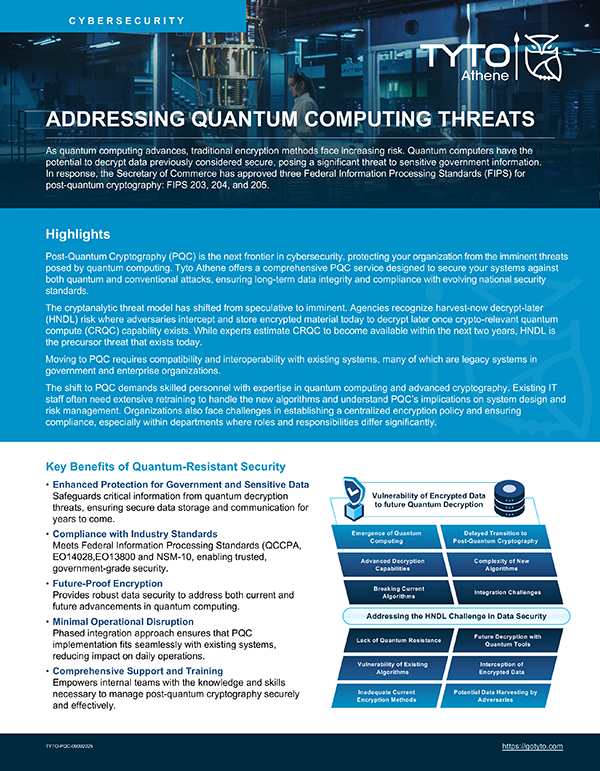
Discover how Tyto Athene helps organizations prepare for the looming threat of quantum decryption with tailored, future-proof encryption solutions aligned with evolving federal standards. You will gain insights into Tyto’s phased PQC implementation, from risk assessments to seamless integration and ongoing support, ensuring data security and compliance in the quantum era.

Strengthening Cybersecurity Through Managed Services

Some core organizational services are complex to implement in terms of the technologies, skills, or applicable regulatory requirements making these impractical for agencies to implement in-house. Therefore, access to shared service providers by federal Government agencies is critical to providing access to services, improving service delivery, and driving cost-efficiency. The federal Government has established the framework for governing shared service centers, but it is up to individual agencies to build and operate the shared service center. This paper summarizes the challenges and provides recommendations for operating a successful shared service center.

Security Orchestration, Automation, and Response (SOAR)

Security Orchestration, Automation, and Response (SOAR) has emerged as a phrase that cybersecurity practitioners immediately recognize and understand in terms of the overall concept and its importance to an effective cyber defense. However, attempts to implement SOAR have faced challenges as technology vendors have co-opted the term to carve out their own product segment, causing implementations to almost exclusively center on a point product implementation. Many organizations have been unable to capitalize on the promise of SOAR and have decided to invest in long-term budget commitments on other technology purchases. Tyto Athene’s approach places Security Operations Center (SOC) functions and capabilities at the center of the discussion and positions SOAR as a methodology, rather than as a technology purchase, which increases the security posture of an organization in the most cost-effective manner.

Modernizing Federal Cybersecurity Risk Managment

Budget cuts, staffing reductions, and rising compliance demands are converging across federal agencies, challenging cybersecurity leaders to maintain risk visibility and readiness with fewer resources. This white paper explores how agencies can modernize their risk management approach using automation, secure cloud platforms, and governance strategies that scale. Featuring insights from Tyto Athene and stackArmor, it outlines a proven path to accelerate ATOs, streamline FISMA compliance, and sustain operational resilience. Ideal for CIOs, CISOs, and security program owners seeking real-world solutions in a constrained environment.

LiFi Networking in the Campus Environment White Paper

This white paper introduces Tyto Athene’s strategy for deploying LiFi in campus environments to address limitations of traditional LAN and Wi-Fi. It explores how LiFi delivers high-speed, secure, interference-free communication using light instead of radio frequencies. The paper details military and commercial use cases, integration architecture, and compliance with emerging standards like IEEE 802.11bb. Learn how LiFi supports Zero Trust, secure mobile operations, and TEMPEST compliance while enabling rapid deployment, lower costs, and enhanced bandwidth for mission-critical scenarios.

DoD365 Integrated Phone System (DIPS) White Paper

Tyto Athene’s DIPS White Paper outlines how the DoD365 Integrated Phone System modernizes voice communications across the Department of Defense. Seamlessly embedded in Microsoft Teams, DIPS enables secure, cloud-based telephony with global reach, high availability, and DoD-grade encryption. Learn how the platform reduces costs, enhances cybersecurity through Army C4ISR monitoring, and supports PIDF-LO for emergency location tracking. This document is essential for mission partners seeking a scalable, future-proof communications backbone that aligns with Zero Trust and integrates emerging tech like 5G and IoT.

RAVID Cyber Defense Strategy White Paper

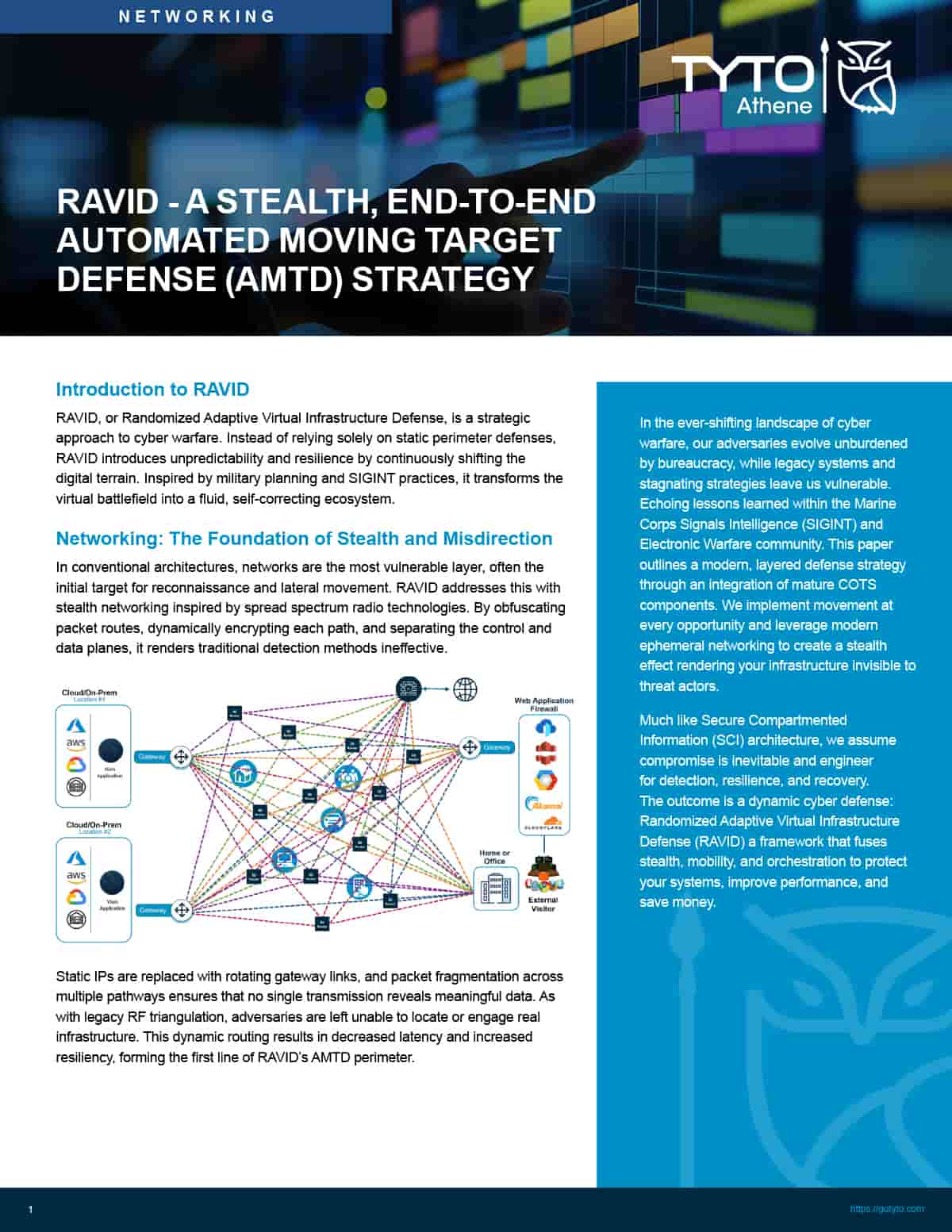
This white paper introduces Tyto Athene’s RAVID strategy, a stealth-based, automated moving target defense (AMTD) approach for modern cyber warfare. Rooted in SIGINT principles, RAVID uses ephemeral infrastructure, packet obfuscation, and smart deception to outmaneuver threat actors. Learn how dynamic routing, AI-driven orchestration, and container mobility make infrastructure invisible and resilient. With reduced cost, increased agility, and actionable telemetry, RAVID transforms static environments into adaptive cyber battlefields. Ideal for cyber leaders seeking a proactive, mission-ready defense strategy.

Software Defined Enterprise (SDE) White Paper

Tyto Athene’s Software Defined Enterprise White Paper presents a visionary strategy for DoD network modernization through SDN, SD-WAN, and SDDC. Learn how orchestration, automation, and attribute-based controls reduce complexity, enhance resiliency, and enable real-time mission responsiveness. The paper outlines integration challenges, human capital needs, and architectural domains, plus how Tyto’s systems integration expertise helps overcome legacy hurdles and drive hyperautomation. It’s an essential read for IT and mission leaders building secure, scalable, and software-driven defense networks.

Software Defined Campus Infrastructure

This white paper outlines how Tyto Athene transforms fragmented, legacy infrastructure into secure, agile, and efficient ecosystems through software-defined automation and Zero Trust architecture, enabling mission readiness, operational efficiency, and cost savings at scale. You will gain strategic insights into Tyto’s proven approach to modernizing campus infrastructure, with real-world results from deployments at Camp Pendleton and Camp Butler.