Tyto Athene | Data to Dominance

Thought Leadership

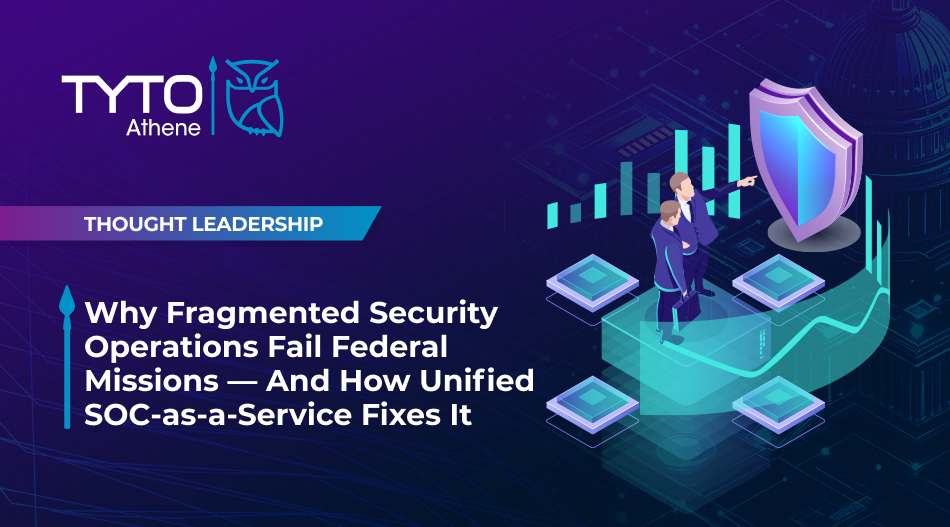
Why Fragmented Security Operations Fail Federal Missions — And How Unified SOC-as-a-Service Fixes It

Federal cyber leaders face a hard truth: deploying more tools does not strengthen mission resilience. 

Threats are accelerating. Zero Trust mandates are expanding. Compliance requirements are tightening. Yet in many environments, Security Operation Centers (SOCs) remain tiered, siloed, and reactive. 

Fragmented SOC models slow response, dilute accountability, and create visibility gaps across agencies. As missions grow more interconnected, operational silos undermine resilience at the enterprise level.  

Mission resilience requires a different approach: a Unified SOC as a Service (SOCaaS) model built for operational continuity, shared defense, and measurable outcomes. 

Stop Managing Alerts. Start Managing Outcomes. 

Many security programs evolve tool by tool: SIEM, EDR, dashboards, and threat feeds. Over time, this creates a layered but disconnected environment. 

When incidents move between multiple tiers and teams, context is lost. When tools are deployed without architectural integration, visibility suffers. When operations remain reactive, resilience weakens. 

A unified SOC model eliminates these silos. Incidents are managed from detection through resolution with continuity, ownership, and enterprise visibility. Detection rules evolve. Automation matures. Intelligence is integrated across environments. 

The result is faster response, stronger situational awareness, and sustained operational improvement. For federal missions, that continuity is not optional. 

Zero Trust Requires Operational Discipline 

Zero Trust is foundational to modern federal cybersecurity strategy. But Zero Trust does not operate on policy alone. 

Continuous authentication requires continuous monitoring. Least-privilege enforcement requires real-time behavioral detection. Policy controls require consistent operational execution.  The SOC is the enforcement engine of Zero Trust. 

SOC Active
ZT Enforcing
Unified SOCaaS + Zero Trust Architecture

The SOC is the Enforcement Engine
of Zero Trust

Integrating Zero Trust with Unified SOCaaS to deliver mission-ready defense
SOC
Zero Trust
Real-Time Validation
Continuous verification of every user and device across all access requests — trust nothing, verify everything.
Immediate Containment
Instant isolation of compromised credentials, stopping lateral movement before damage spreads.
Continuous Monitoring
Full-spectrum visibility spanning hybrid environments — on-premises and cloud, unified under one lens.
Coordinated Response
Threat response aligned to agency mission priorities — not just technical incidents in isolation.
"

Prevention and response become a single operational framework —
not separate initiatives.

Why Traditional SOC Models Break Down 

Even capable internal teams face structural challenges: 

  • Talent shortages and turnover 
  • Increasing technology complexity 
  • 24/7 coverage demands 
  • Disconnected tools and manual processes 

        Over time, these pressures degrade performance and limit scalability. Many SOCs remain trapped in reactive alert handling rather than proactive defense. 

        Unified SOCaaS addresses these barriers by delivering sustained expertise, engineering-driven automation, and integrated service architecture without expanding internal overhead. 

        What to Demand from a SOC-as-a-Service Partner 

        Choosing a SOCaaS provider is not about price alone. It is about operational maturity. 

        Look for: 

        • End-to-end incident ownership 
        • Automation and orchestration embedded in workflows 
        • Zero Trust alignment and enforcement capability 
        • Continuous refinement of detection and response processes 
        • A collaborative partnership model, not merely transactional monitoring 

                Security operations should not just function. They should improve over time. 

                Tyto Athene: One Team. One SOC. One Mission. 

                Tyto Athene delivers Unified SOCaaS built specifically for federal environments. 

                Through our Security Operations Centers, including the MPGSOC, we provide: 

                • 24/7 monitoring and rapid incident response 
                • Integrated cyber threat intelligence 
                • Zero Trust-aligned enforcement 
                • Engineering-driven automation and orchestration 
                • Continuous improvement of detection workflows 

                        We design service architectures around outcomes first, aligning people, process, and technology to deliver measurable resilience. 

                        If fragmented SOC operations are limiting your visibility and slowing response, it is time for a unified approach. 

                        Discover how Tyto Athene’s Unified SOCaaS strengthens federal cyber resilience from detection to resolution. Contact Us.

                        Tyto Athene and MindPoint Group (a Tyto Athene company), deliver Unified SOC-as-a-Service to federal civilian agencies, combining 24×7 security operations, proactive threat management, and strategic governance within a fully integrated service model. With FedRAMP-authorized platforms, experienced security practitioners, and proven shared services governance, we help agencies achieve comprehensive security without the complexity of managing multiple vendors or building capabilities internally.